Where Your Downspouts Dump Water: Gutters, Clay Soil, and Foundations in Tolar, TX
A gutter that works perfectly can still wreck the ground next to your house. How many downspouts you need, where they belong, how far the water has to go, and why North Texas clay makes the answer different here.
Have a gutter question about your Granbury home?
Call (817) 326-3682Your gutters can be in perfect condition and still be causing the most expensive problem on your property.
A gutter's job is only half finished when it catches the water. The other half is getting that water somewhere it cannot hurt anything, and that is the half nobody inspects. We see immaculate seamless runs, correctly pitched, no clogs, dumping the entire roof's worth of water three feet from a slab.
Tolar is ranching and rural community country, with homes spread across larger lots on the western side of Hood County. Longer rooflines mean more water arriving at fewer points, and acreage properties rarely have the municipal storm drainage that takes the problem off your hands. Where the water goes is entirely up to how the system was set up.
Here is what actually matters about downspouts — how many, where, and how far. For a free on-site evaluation, call (817) 326-3682.
The Arithmetic Nobody Runs
One inch of rain on a 2,000 square foot roof produces roughly 1,250 gallons of water. That is not an estimate meant to alarm you, it is just area times depth: 2,000 square feet of roof collecting an inch of rain is about 167 cubic feet, and a cubic foot holds about 7.5 gallons.
A 3,000 square foot ranch roof under a two-inch rain event is moving somewhere near 3,700 gallons. All of it arrives inside a couple of hours, and all of it leaves through however many downspouts happen to be on the house.
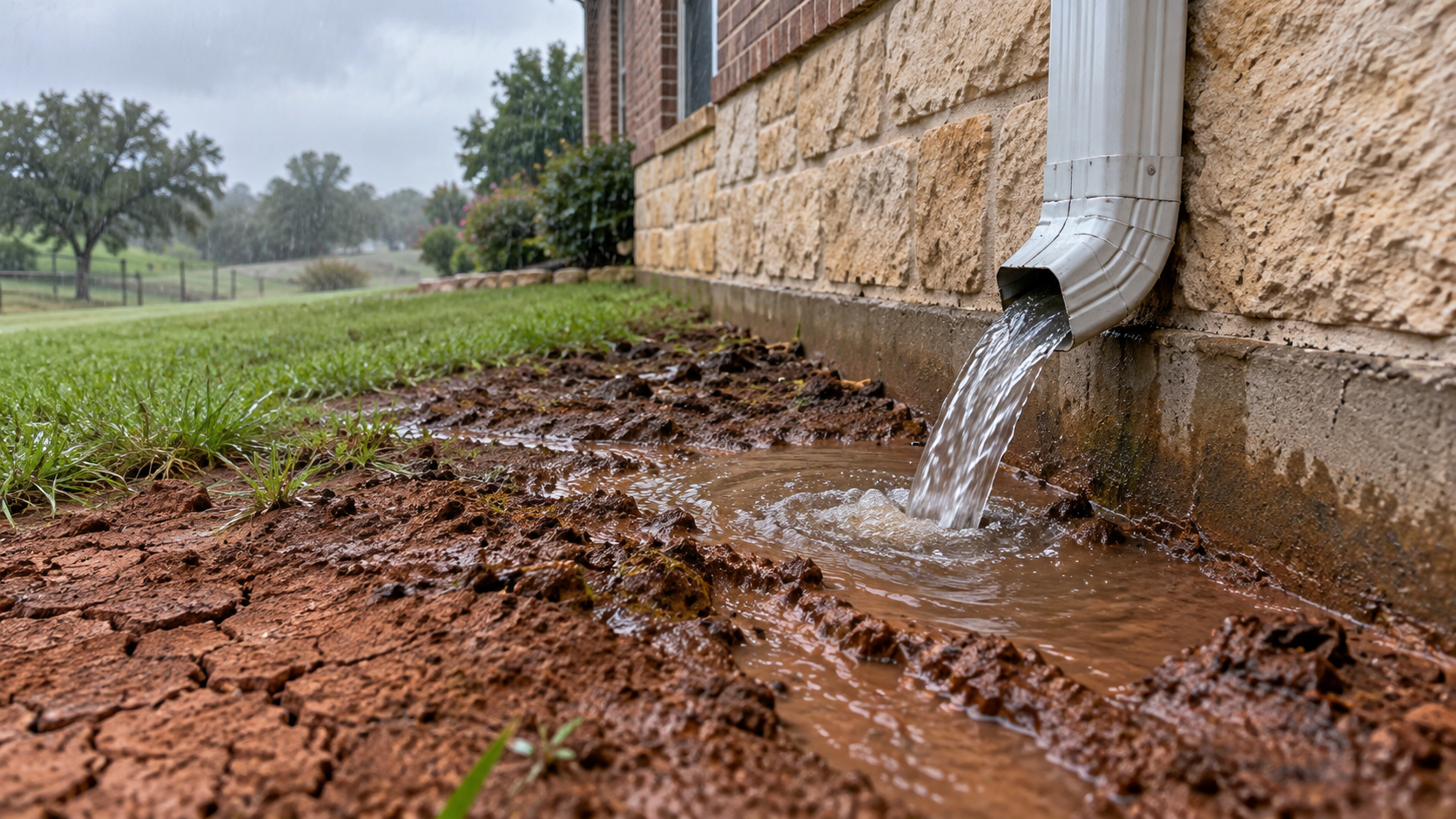
Now picture that volume discharging at one corner, eighteen inches from the slab, into soil that has been baking since June.
That is not a gutter problem. The gutter did its job. It is a discharge problem, and it is the single most common thing we find on otherwise healthy systems.
Why North Texas Clay Changes the Stakes
In much of the country, water next to a house is a nuisance. Here it is a structural issue, because of what the soil does.
Clay-heavy soil around Granbury foundations is sensitive to pooling water, and the same ground runs west through Tolar and Lipan. The behavior that makes clay difficult is simple: it swells when it takes on water and shrinks when it dries out. Those are large volume changes, not small ones, and they happen unevenly across a lot.
A slab sitting on soil that is saturated at one corner and bone dry at the opposite corner is not being supported evenly. That differential is what moves foundations, and it is worse than uniform wetness or uniform dryness would be.
Then consider the August pattern specifically. Six to eight weeks of heat with little rain pulls the moisture out of clay and it contracts, opening gaps and pulling away from the slab edge. Then the first real storm of the season arrives and dumps a thousand-plus gallons into exactly that gap, all at once. The soil takes on water fast, swells fast, and does it in the one spot the downspout points at.
Spreading that water out and moving it away is not landscaping detail. It is the cheapest structural protection available on a house.
How Far Is Far Enough
The common guidance is to discharge water several feet from the foundation, and further is better. The reason that number is a range rather than a rule is that it depends on your grade.
What actually determines the answer:
- Which way the ground falls. Water discharged onto ground that slopes back toward the house has not been moved anywhere, regardless of how far the extension reaches.
- How much volume that downspout carries. A downspout serving eight feet of roofline and one serving sixty feet are not the same problem, and should not get the same solution.
- What the soil is doing. Compacted clay sheds water sideways rather than absorbing it, so discharge tends to travel along the surface — which can work for you or against you depending on grade.
- What is downhill. Moving water away from your slab and onto a neighbor's, or into a driveway that channels it back, solves nothing.
The honest version: the right discharge distance is the distance at which the water is visibly leaving and not coming back. That gets determined standing on the lot, watching where water actually runs, which is part of what a real evaluation involves.
How Many Downspouts Do You Actually Need
More than most houses have. That is the short answer, and it is especially true on long rural rooflines.
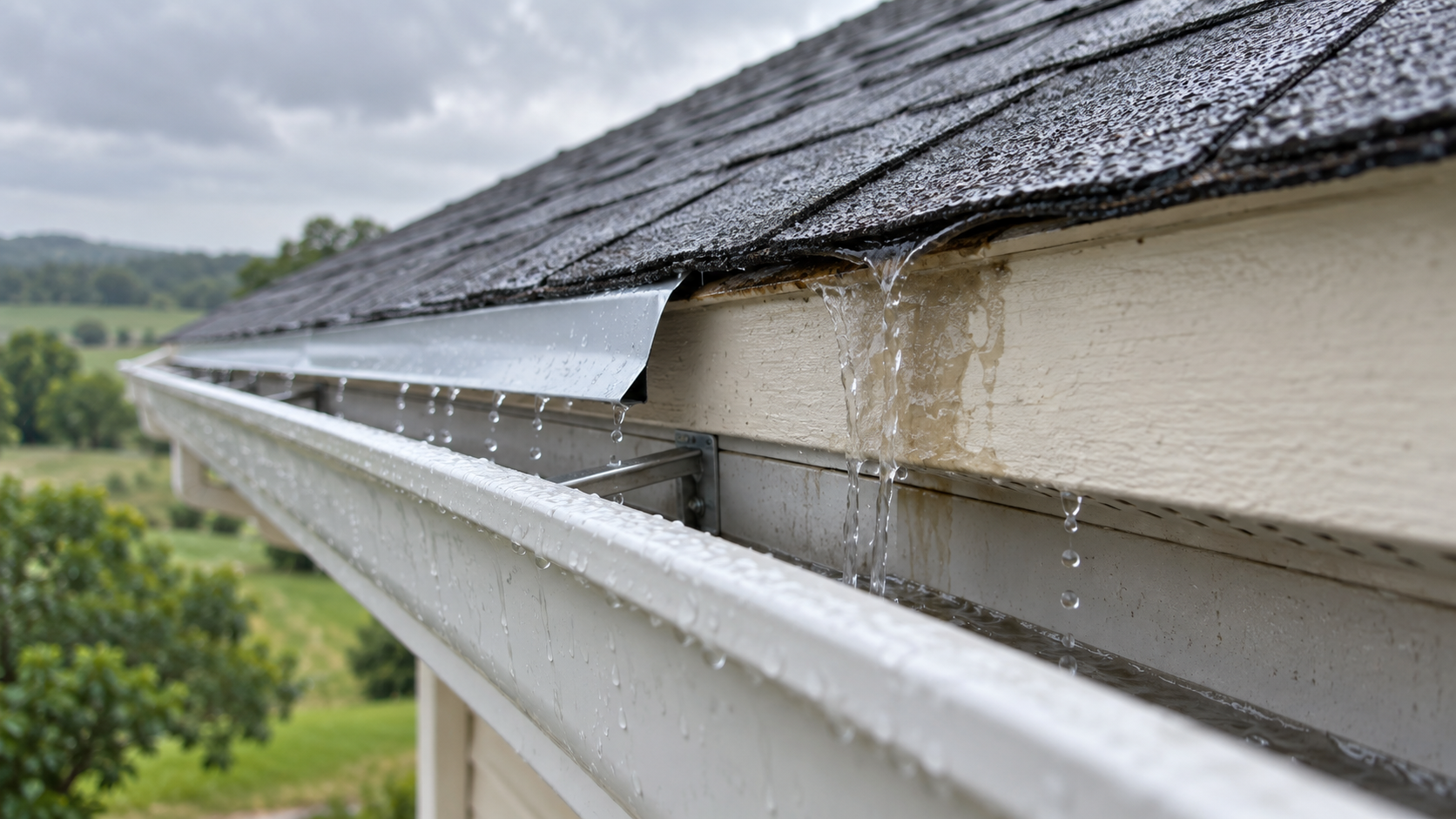
A downspout is a drain, and like any drain it has a throughput limit. Water arriving faster than the downspout can take it does not wait politely — it backs up along the gutter, finds the lowest point, and goes over the edge. Homeowners see that overflow and assume the gutter is clogged. Sometimes the gutter is fine and simply has nowhere to put the water.
What drives the count:
- Total roof area feeding each run. The gutter is a conveyor; the downspout is the exit. A long conveyor needs more exits.
- Roof pitch. Steeper roofs deliver water to the gutter faster, which raises the peak flow rate rather than the total volume.
- Where the valleys are. A roof valley concentrates a large area into a narrow point, and the gutter beneath a valley receives a disproportionate surge.
- Run length and slope direction. Water has to physically travel to the downspout. A very long run pitched to a single end is asking a lot of both the pitch and that one outlet.
- Downspout size. A larger downspout moves considerably more water than a smaller one, so the count and the size trade off against each other.
Longer rooflines on Tolar's ranch-style homes are formed as one continuous seamless run on-site, cutting down on the joints that tend to leak first. That solves the seam problem, and it makes the outlet question more important rather than less: a single unbroken sixty-foot run still needs somewhere for sixty feet of roof water to exit.
A full cleaning and downspout check keeps water moving off long rural rooflines instead of backing up partway through the run. If your gutters overflow in the same spot every heavy rain and they are not clogged, you are looking at a capacity problem, not a maintenance one. Gutter cleaning and inspection will establish which.
Where Downspouts Belong
Placement is a compromise between hydraulics and everything else, and the compromise is usually resolved badly.
Water wants the downspout at the low point of the run. The homeowner wants it where it is least visible. The landscaping wants it away from beds. The grade wants it where the ground already falls away. Those four rarely point at the same corner.
Things That Get Placement Wrong
- Putting it at the most convenient corner rather than the end the gutter is actually pitched toward, which forces water to travel uphill or sit.
- Discharging above a walkway or driveway, where the hard surface routes water back toward the house instead of into soil.
- Clustering outlets on one elevation because that is where the existing plumbing chases run, concentrating the entire roof's water on one side of the slab.
- Discharging into a bed against the wall. Mulch and loose soil absorb readily, which puts a large volume of water directly against the foundation — the opposite of the goal.
- Dumping one downspout onto a lower roof section without accounting for the extra load that lower gutter now carries.
What Good Placement Looks Like
Outlets at the genuine low points of each run, distributed across elevations so no single stretch of slab takes the whole roof, discharging onto ground that falls away from the house, and clear of hard surfaces that would redirect the flow.
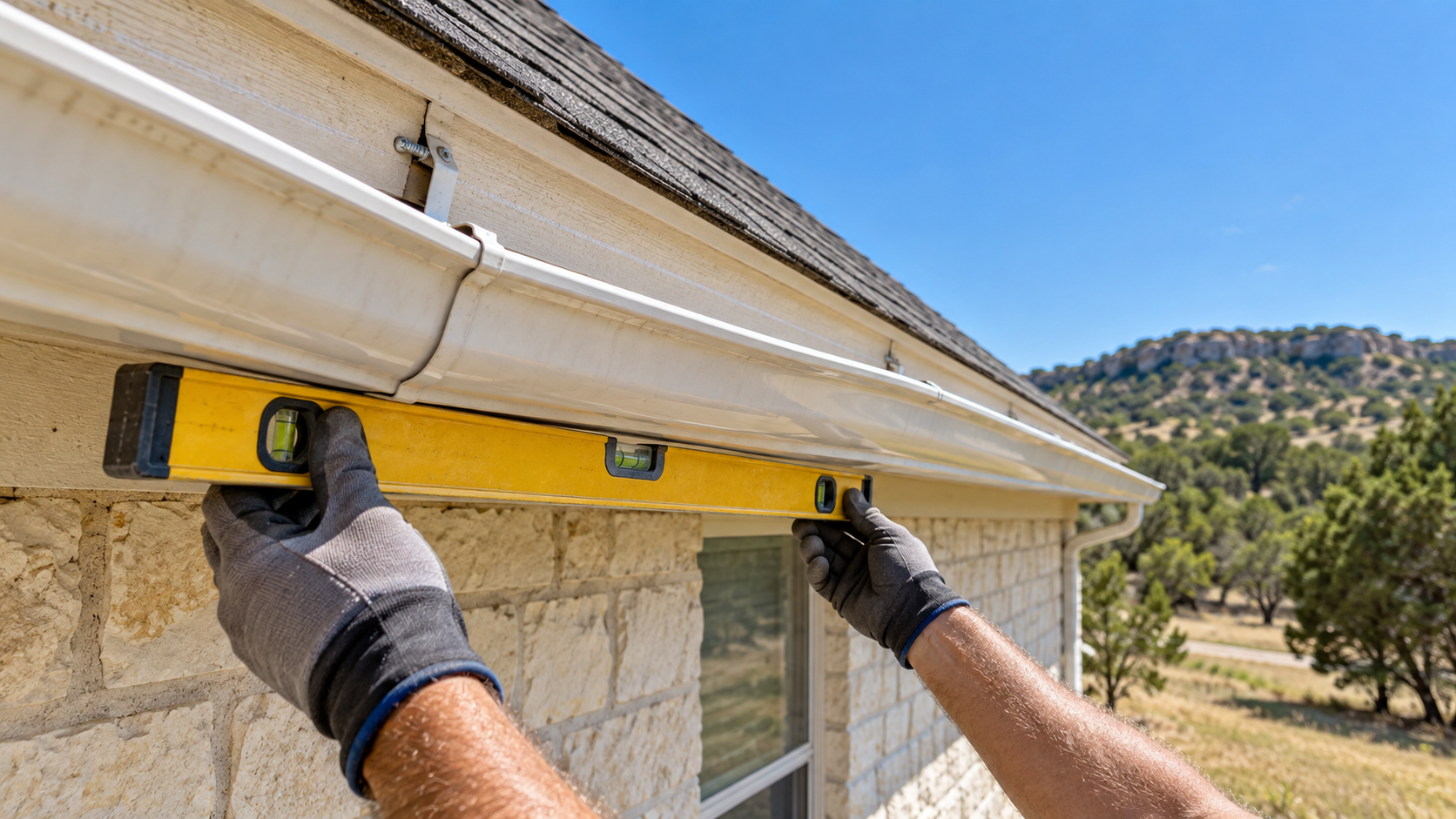
On older Tolar properties, wide-open acreage exposes gutters to more direct wind, a frequent cause of the sagging and loosened fasteners we get called out for around Tolar. Wind-loosened runs shift pitch, and a shifted pitch quietly relocates the low point away from the downspout — so placement that was correct at installation may no longer be. Gutter repair addresses the fastening and the pitch together, because fixing one without the other does not last.
Discharge Options, Honestly Compared
Splash Blocks
A concrete or plastic block under the outlet that breaks the force of the water and spreads it. Cheap, visible, and better than nothing.
What they do well: stop the water from digging a hole and eroding soil at one point. What they do not do: move water away. A splash block discharges roughly where the downspout already was. On a house with grade falling away sharply, that may be enough. Against a slab on flat clay, it is not.
Above-Ground Extensions
A length of pipe or flexible tubing carrying water further out before releasing it. This is the most common fix and usually the right first move.
Advantages: inexpensive, reversible, easy to adjust if you got the distance wrong, and easy to inspect. Disadvantages: visible, in the way of mowing, and the flexible kind gets kicked loose, crushed, or disconnected — often without anyone noticing until damage shows up. If you use these, checking that they are still attached belongs on your maintenance list.
Buried Drain Lines
Solid pipe running underground from the downspout to a discharge point well away from the house, often daylighting downhill.
This is the best-performing option when it is done correctly, and the worst when it is not. Done right, water leaves the building envelope entirely and nothing is visible. Done wrong — insufficient fall, undersized pipe, no cleanout access, or a discharge end that silts up — you have built a buried reservoir next to your foundation, and you will not find out until the damage is done.
The non-negotiables are real fall along the whole length, adequate pipe diameter for the volume calculated above, and access to clear it.
French Drains and Gravel Trenches
A perforated pipe in gravel meant to collect and disperse water through the soil rather than carry it to a single outlet.
These have a place, but they are frequently the wrong tool for downspout discharge specifically. A french drain disperses water into the surrounding ground. If that ground is the clay next to your slab, you have engineered a slow-release soaking system in the exact location you were trying to protect. Dispersal drains belong well away from the structure, not against it.
What We Do, and What We Do Not
Being straight about this, because the line matters.
We handle gutters and downspouts: sizing, placement, the outlets themselves, the connections, and where the discharge is aimed. That is our trade and we will tell you plainly what your system needs.
We are not a foundation company. If your slab has already moved — visible cracking, doors out of square, separation at brick courses — that needs a foundation specialist, and we will say so rather than selling you gutters as a cure. Getting the water under control is what stops the cause from continuing. It does not reverse movement that has already happened.
Anyone who tells you new gutters will fix a foundation is selling you something. What correct drainage does is remove one of the largest and most controllable variables acting on the soil under your house.
The August Job List
Late summer is the right time for this work, for a practical reason: the ground is dry and workable, and you are ahead of the fall rains rather than behind them.
Walk the Perimeter After the Next Storm
Not during — after. Look at where the ground is wet and where it is scoured. Wet soil against the slab tells you the whole story and no measurement is required.
Check Every Extension Is Still Connected
Flexible extensions come apart constantly and nobody notices. A disconnected extension is functionally the same as having no extension.
Look for the Dug-Out Spot
A depression, a scoured trench, or exposed soil under an outlet means the water has enough force and volume to move dirt. It is moving dirt from under the edge of your slab too.
Count Your Downspouts Against Your Roofline
If one run of thirty-plus feet has a single outlet, and that run overflows in heavy rain, you have your answer.
Verify the Gutters Themselves Are Clear
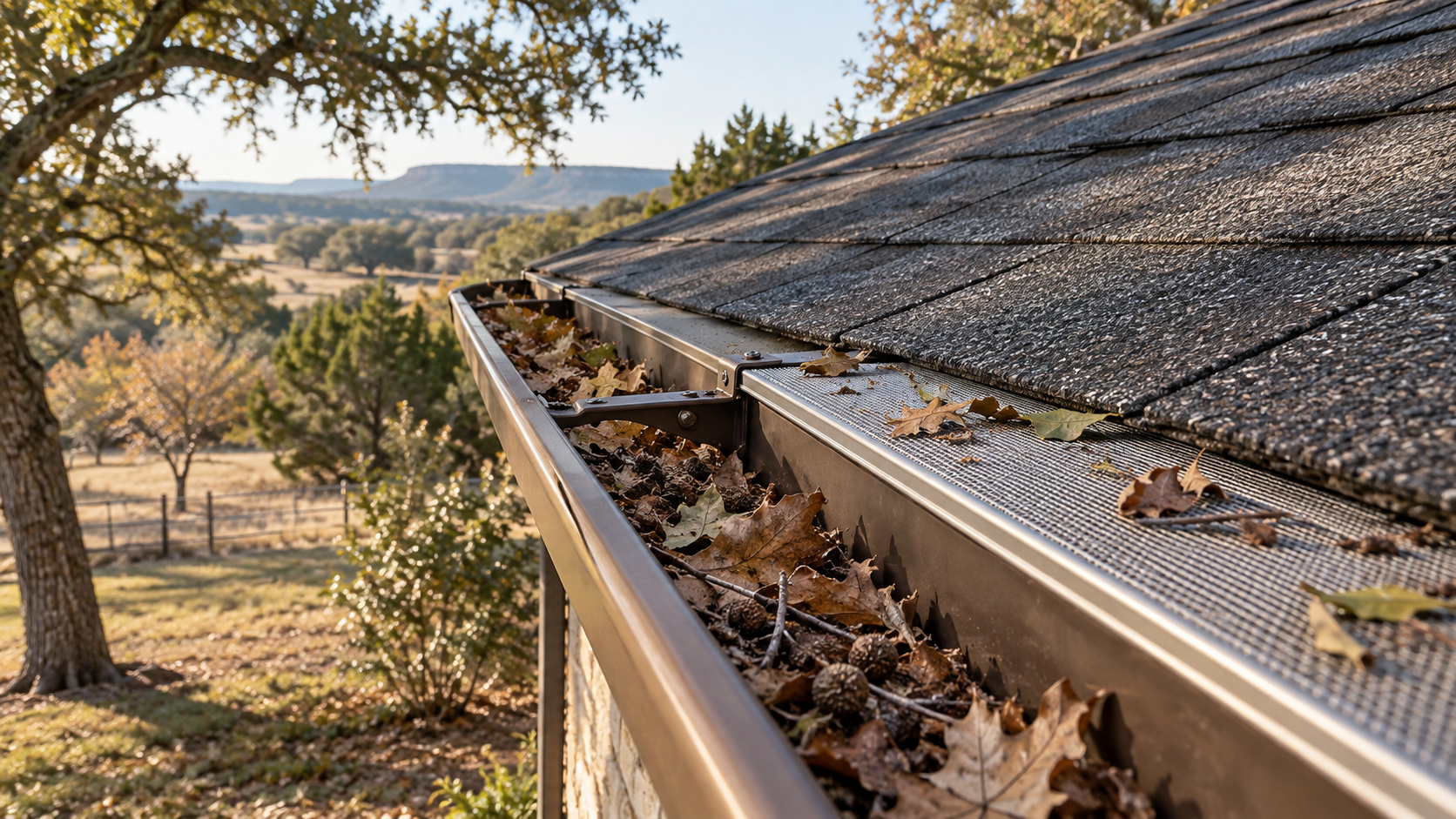
None of the above matters if water never reaches the downspout. A properly fitted gutter guard system reduces how often that becomes the limiting factor, particularly with debris from surrounding fields and tree lines.
Frequently Asked Questions
How far should downspouts drain from the house?
Several feet at minimum, and further on flat lots or where a downspout carries a large roof area. The number matters less than the result: the water should visibly leave and not run back. On ground that slopes toward the house, no extension length is sufficient on its own.
How many downspouts do I need?
It depends on roof area feeding each run, roof pitch, valley locations, run length, and downspout size. The practical test is simpler than the calculation — if a run overflows in heavy rain while clear of debris, it does not have enough outlet capacity.
Can gutters cause foundation damage?
Gutters that discharge water against the house contribute to the soil moisture swings that move foundations, particularly in clay. The gutter is not damaging the foundation directly; the concentrated water it delivers to one spot is.
Why does water pool next to my foundation?
Usually one of three things: the downspout discharges too close, the grade falls toward the house instead of away, or a buried drain line has silted up and stopped carrying water. All three are worth ruling out before assuming a grading problem.
Do splash blocks work?
They stop erosion at the discharge point, which is worth something. They do not move water away from the house. On a flat clay lot next to a slab, a splash block alone is rarely enough.
Are buried downspout drains a good idea?
When installed with real fall, correct pipe size, and a cleanout, yes — they are the best-performing option available. When installed without those, they become a hidden reservoir next to the foundation. The installation quality matters more here than with any other option.
Should I run my downspouts into a french drain?
Usually not right next to the house. A french drain disperses water into the surrounding soil, and dispersing a roof's worth of water into the clay beside your slab is the opposite of the goal. Dispersal works well away from the structure.
My gutters overflow but they are clean. Why?
Almost always capacity. Water arriving faster than the downspouts can take it backs up the run and over the edge. Add an outlet, increase the downspout size, or correct the pitch so water actually reaches the existing outlet.
Does downspout size matter more than count?
They trade off. A larger downspout moves substantially more water than a smaller one, so upsizing can sometimes accomplish what adding an outlet would. Which approach is better depends on the roofline and where an additional outlet could realistically go.
Why is this worse in August?
Because clay that has dried and contracted for weeks takes on water fast when the first storm hits. The swelling happens quickly and unevenly, concentrated wherever the downspouts point — which is harder on a slab than gradual, even wetting.
Do I need new gutters to fix my drainage?
Often not. Adding or relocating downspouts, upsizing outlets, and correcting discharge can frequently be done on a sound existing system. Replacement is the answer when the gutters themselves are undersized or failing, not simply because the drainage is wrong.
Get the Water Moved Before the Fall Rains
The gutters are the easy part. Where the water ends up is what decides whether the system is actually protecting the house.
Call Granbury Gutters at (817) 326-3682 for a free on-site evaluation. We are open Monday through Friday from 8 to 5 and Saturday from 9 to 1, closed Sunday. We are BBB Accredited and rated 4.9 out of 5 on Google — see what customers say on our reviews page.
We will count the outlets against your roofline, check where each one discharges and which way your ground actually falls, and tell you whether you need more capacity, different placement, or just a longer run of pipe. Longer rooflines on ranch-style homes get seamless gutters formed on-site to the actual length of the run, sized for the water that roof genuinely produces.
We are a Granbury-based team, not a call center dispatching to whoever is available, and we serve Tolar and the surrounding area from our shop at 1019 Davis Road in Granbury.