What Size Gutters Do You Need? 5-Inch vs 6-Inch for Pecan Plantation, TX Homes
Most gutter problems are sizing problems. What decides whether your home needs 5-inch or 6-inch gutters, how many downspouts it takes, and why the roof decides, not the catalog.
Have a gutter question about your Granbury home?
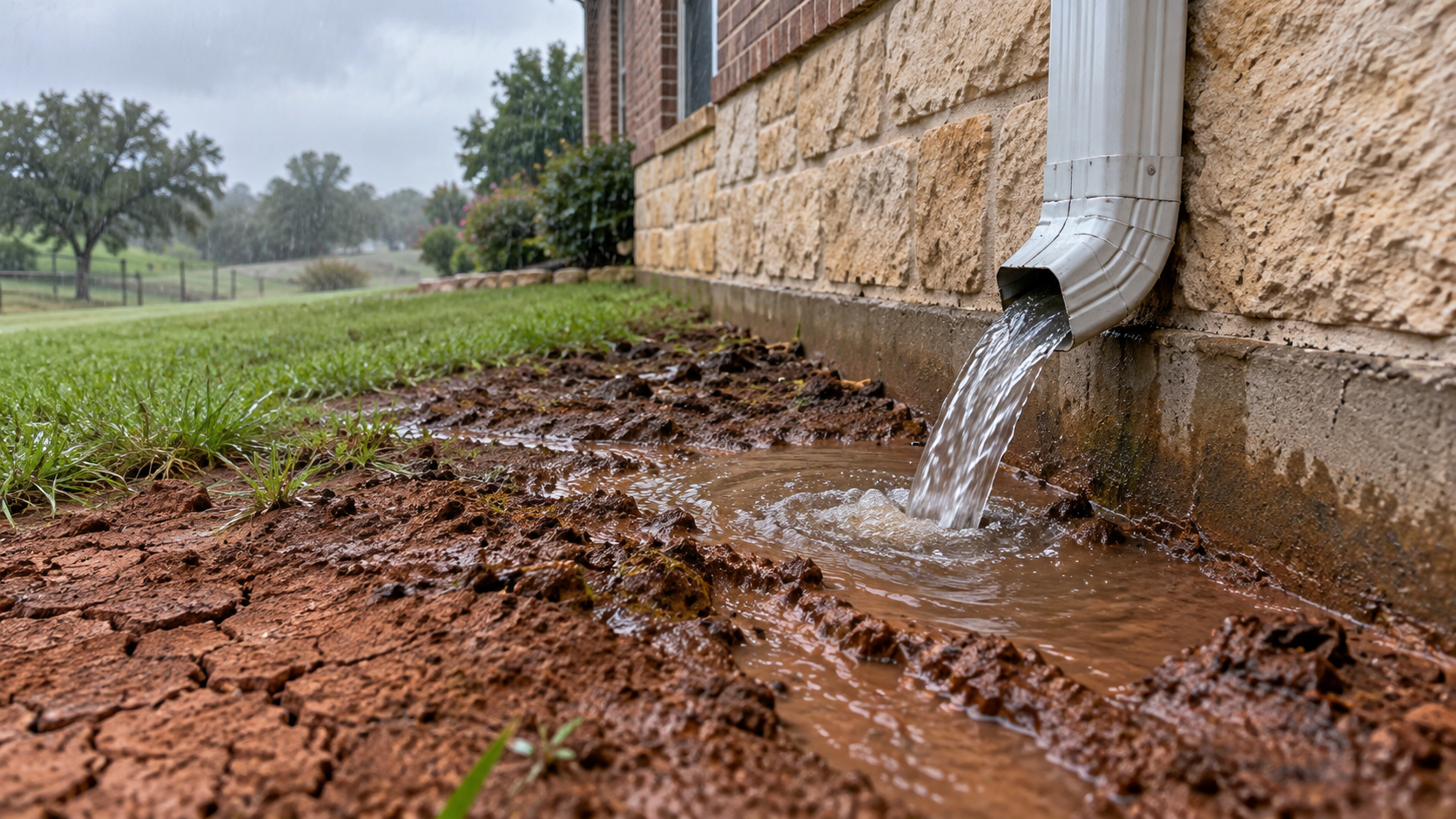
Call (817) 326-3682Most of the gutter failures we get called out to look at in April are not really failures. The hardware held, the seams held, the pitch was fine. The gutter simply could not carry the water that came off the roof, so it went over the front edge instead.
That is a sizing problem, and it is the one problem you cannot fix later without replacing the run. Pitch can be corrected. Hangers can be added. Seams can be sealed. A trough that is too small for the roof above it stays too small for as long as it is on the house.
Spring is when this becomes obvious in Hood County, because spring is when we get rain hard enough to test the system. If you watched water sheet over your gutters during a March storm and you are now wondering whether to fix them or start over, sizing is the question to answer first.
This guide covers what actually decides gutter size, the honest difference between 5-inch and 6-inch, how downspouts change the math, and why the answer comes from the roof rather than from a catalog. For a free on-site evaluation, call us at (817) 326-3682.
What Gutter Size Actually Means
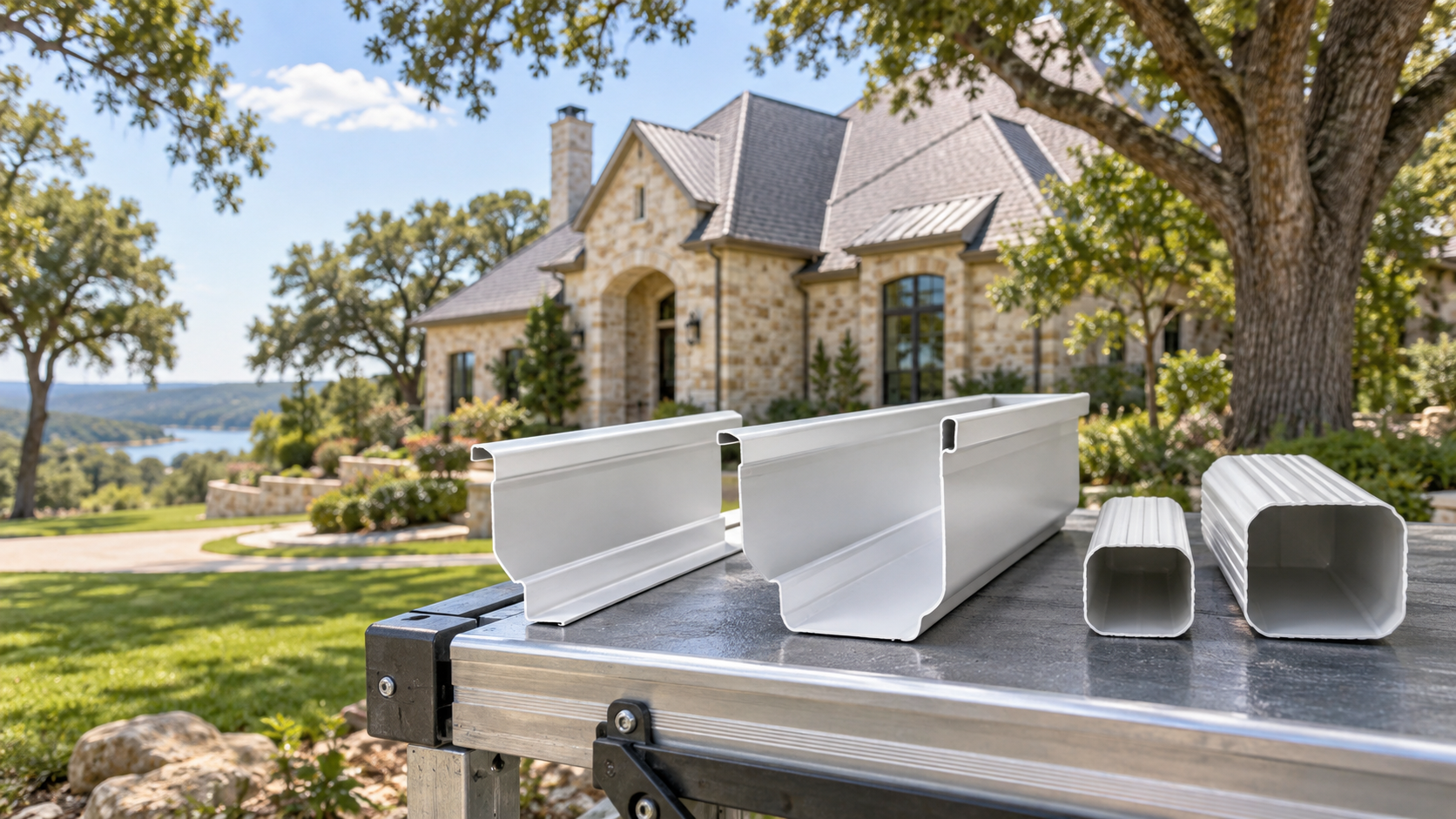
Gutter size is stated as the width across the top opening of the trough. A 5-inch K-style gutter measures five inches across that opening, a 6-inch measures six.
That one inch sounds trivial. It is not, for two reasons.
The first is cross-section. Going from 5-inch to 6-inch adds capacity across the whole depth of the channel, not just the lip, so the volume of water the trough can move is meaningfully higher rather than fractionally higher.
The second is the downspout that comes with it. A 5-inch gutter is typically paired with a 2x3-inch downspout, and a 6-inch gutter with a 3x4-inch. The downspout is where water actually leaves, and that outlet difference is substantial. A gutter is only as good as its drain.
There is also gutter profile to consider, which is separate from size. K-style is the ridged, angular profile most North Texas homes have. Half-round is the rounded trough seen on historic and custom homes. Our traditional and half-round gutters are a different conversation from sizing, and we cover profile choice separately.
The Five Things That Decide Your Size
Nobody can tell you your gutter size from the street, and any number quoted before someone has looked at your roof is a guess. Here is what the answer actually depends on.
Roof Area Draining to That Run
Not the square footage of your house. The area of roof that funnels water into one specific length of gutter. A modest home with one long roof plane feeding a single run can need more capacity than a larger home where the water is split four ways.
Roof Pitch
A steeper roof moves water faster and throws it further out past the edge. Two homes with identical roof area and different pitches do not have the same gutter requirement, and the steeper one is harder to catch.
Rainfall Intensity
Sizing is driven by the hardest rain your area gets, not the average. North Texas gets short, violent downpours, and a system sized for a gentle steady rain will overflow in the first real storm of the season. This is the single most common reason an otherwise correct-looking gutter spills.
Valleys and Concentrated Flow
A roof valley collects water from two planes and delivers it to one point in the gutter at high speed. The trough below a valley is the first place water escapes on almost every home. Complex rooflines have more of these, which is why cut-up roofs need more capacity than their total area suggests.
Number and Placement of Downspouts
Every downspout you add shortens the distance water has to travel inside the trough before it can leave. This is the lever most homeowners do not know they have, and it often matters more than the extra inch of width.
Homes throughout Pecan Plantation's mature, tree-lined streets get a seamless system formed on-site to match rooflines shaped by decades of established landscaping, which means the sizing is decided per home rather than per subdivision.
When 5-Inch Is Enough
Five-inch K-style is the default on most North Texas homes, and for a lot of them it is genuinely the right answer. Oversizing a gutter that does not need it is wasted money and, on some rooflines, looks wrong.
Five-inch tends to be appropriate when:
- The roof is simple, with large uninterrupted planes and few valleys
- The pitch is moderate rather than steep
- Each run is short enough to reach a downspout quickly
- There is room for enough downspouts to keep any single one from being overwhelmed
- Tree cover is light, so debris is not competing with water for space in the channel
- The existing 5-inch system has performed well through past storms
That last point is worth weighting heavily. If your current gutters only overflow in one specific spot, you may not have a size problem at all. You may have a downspout placement problem, a pitch problem, or a valley dumping into a dead end.
When 6-Inch Is the Right Call
Six-inch costs more and it is heavier, which means the hanger spacing has to account for it. It earns that in the situations below.
- Steep roofs, where water arrives fast and with force
- Large roof planes feeding a single long run
- Multiple valleys concentrating flow into one section of gutter
- Long runs where a downspout cannot be placed close enough
- Heavy tree cover, where debris permanently occupies part of the channel
- Metal roofs, which shed water faster than shingles
- A documented history of overflow in hard rain despite correct pitch and clear troughs
- Homes where the overflow lands somewhere that matters, like against a foundation or over a walkway
Pecan Plantation is the clearest local example of the tree-cover case. It is a large, tree-lined community along the Brazos River, and its mature landscaping means gutters here work harder than most. Few areas we serve have as much year-round tree cover. When a channel is carrying pecan drop and leaf litter year-round, the effective capacity is smaller than the stated capacity, every single day.
When an older home's gutters in Pecan Plantation cannot keep up with the debris and water volume from mature trees, a right-sized seamless system solves it. That is gutter replacement work where the size change is the actual fix, not a sales upgrade.
Downspouts Matter More Than People Think
If you take one thing from this, take this. Homeowners debate 5-inch versus 6-inch and then accept whatever downspout count they are given, which is backwards.
Water entering the trough has to travel sideways to the nearest outlet. The longer that trip, the deeper the water gets along the way, and the more likely it is to reach the front lip before it reaches the drain. Adding a downspout cuts that travel distance immediately.
What we look at:
- Total count relative to run length. Long runs with a single downspout at one end are a common inherited problem.
- Outlet size. A 3x4-inch downspout moves substantially more than a 2x3-inch, which is part of why the 6-inch conversation and the downspout conversation are really one conversation.
- Placement relative to valleys. Putting an outlet near where a valley dumps means that concentrated flow leaves the system almost immediately.
- Elbow count. Every turn slows water down. A downspout with several offsets does not perform like a straight drop.
- Debris tolerance. Under heavy tree cover, a larger outlet is far less likely to choke on a seed pod or a wad of leaves.
- Where it discharges. A downspout that drains correctly into a bed next to the foundation has solved the gutter's problem and created the house's problem.
Falling branches and heavy pecan drop are common causes of dented sections and pulled fasteners we address throughout the community, and a dented downspout has a smaller working cross-section than a clean one. Damage reduces capacity even when the size on paper has not changed.
Why Seamless Changes the Sizing Conversation
Sectional gutters come in fixed lengths and get joined together on the house. Every joint is a place where water can escape and debris can catch, and on a run that is already near its capacity limit, those joints fail first.
Our seamless gutters are aluminum, fabricated on-site and formed to the exact length of each section. That matters for sizing in a practical way: we are not fitting your roof to stock lengths, so the run is continuous from end to end and the only openings in it are the ones we chose to put there. Most residential homes are fitted in a single day.
It also means the size decision happens at your house, with the roof in front of us, rather than being ordered in advance from a measurement over the phone. If a run needs 6-inch and the one beside it does not, that is a decision we can make on-site.
Our seamless gutter installation page covers the process itself. The sizing is part of the free on-site evaluation, not a separate charge.
How to Tell If Your Gutters Are Undersized
You can get most of the way to an answer yourself. The trick is to check during hard rain, not after.
Signs pointing to undersizing:
- Water sheeting over the front edge of the gutter along a length of the run, not just at one point
- Overflow that happens in heavy rain but never in light rain
- Water shooting past the gutter entirely below a valley
- Overflow that persists immediately after a cleaning, when the trough is known to be clear
- The same run failing year after year regardless of repairs
- Water backing up at the top of a downspout instead of draining down it
- Erosion channels or splash-back staining along one specific section of wall
Signs pointing to something other than size:
- Overflow at a single joint or seam, which is a repair
- Water pooling in one dip in the run, which is a pitch problem
- Overflow that stops after the gutter is cleared, which is a debris problem
- A visible sag, which is hardware
- Dripping behind the gutter at the fascia, which is often flashing or drip edge
The distinction is worth making before you spend anything. Replacing a correctly sized system because it was full of leaves is an expensive way to solve a cleaning problem.
With pecan and leaf drop this heavy, full-channel cleaning and a downspout check are worth doing more than the typical twice-a-year schedule. Do the gutter cleaning first, watch it in the next real rain, and then judge the size.
Can Gutter Guards Substitute for a Bigger Gutter?
No, and it is worth being direct about that because it gets sold the other way around.
Guards manage debris. They keep the channel clear so the capacity you have stays available. What they do not do is add capacity. A 5-inch gutter with a guard on it is still a 5-inch gutter, and in a hard enough rain some guard designs actually slow water entering the trough.
Where guards genuinely help is the interaction between the two problems. Under heavy tree cover, an undersized gutter that is also half-full of debris fails constantly, and clearing the debris is the cheaper half of the fix. A well-fitted guard system meaningfully cuts down on maintenance frequency in areas with this much tree cover.
The honest sequence is: size the gutter for the roof, then add gutter guards to protect that capacity. Not the reverse.
Frequently Asked Questions
What size gutters do I need for my house?
It depends on the roof area draining into each individual run, the roof pitch, how many valleys concentrate flow, and how many downspouts the layout allows. Five-inch K-style is correct for most simple North Texas rooflines. Steep roofs, long runs, multiple valleys, metal roofing, and heavy tree cover push toward 6-inch. The determination has to be made at the house.
Are 6-inch gutters worth it?
They are worth it when the roof calls for them, and wasted when it does not. If your current gutters overflow along a whole run during hard rain with a clear trough and correct pitch, 6-inch addresses the actual cause. If they overflow at one seam or after leaves build up, a repair or a cleaning is the real fix.
What is the difference between 5-inch and 6-inch gutters?
The stated number is the width across the top of the trough. The practical differences are total channel capacity and the downspout that pairs with it, since 5-inch usually runs a 2x3-inch downspout and 6-inch a 3x4-inch. The downspout difference is a large part of the performance gap.
How many downspouts do I need?
Enough that water never has to travel far inside the trough to reach one. Long runs served by a single downspout at one end are a frequent cause of overflow even on correctly sized gutters. Placement matters as much as count, especially putting an outlet near where a valley discharges.
Will bigger gutters stop my gutters from overflowing?
Only if the overflow is caused by capacity. Overflow from debris, lost pitch, a failed seam, or a valley dumping past the gutter will continue on a larger system. Clear the trough, watch it in the next hard rain, and diagnose from what is left.
Do seamless gutters come in different sizes?
Yes. Seamless refers to how the gutter is made, not its dimensions. Ours are aluminum, fabricated on-site and formed to the exact length of each section, and we form them in the size the roofline requires rather than joining stock pieces together.
Does a steep roof need bigger gutters?
It often does. A steeper pitch moves water faster and throws it further past the roof edge, so the trough has less time to capture it and more volume arriving at once. Pitch is one of the main reasons two homes with the same roof area need different systems.
Do I need gutters at all in Texas?
For most homes, yes. Texas rain arrives in short heavy bursts, which is exactly the pattern that dumps large volumes of water at the base of a wall in a short time. Gutters exist to move that water away from the foundation, and foundation movement is a well-known concern in North Texas soils.
Can I mix 5-inch and 6-inch gutters on the same house?
You can, and sometimes it is the correct answer. If one elevation has a large roof plane and several valleys feeding one run while the rest of the house is simple, sizing that run up and leaving the others alone is reasonable. Forming on-site is what makes it practical.
Get the Size Decided Before You Buy the Gutter
Spring is the right time to sort this out, because you have just watched your current system handle real rain and you still remember where the water went.
Call (817) 326-3682 for a free on-site evaluation. We will look at the roof planes, the pitch, the valleys, and the downspout layout, and tell you what the roof actually needs, including when the honest answer is that your existing 5-inch system is fine and something else is wrong. We are open Monday through Friday from 8am to 5pm and Saturday from 9am to 1pm.
We cover Pecan Plantation and the surrounding communities from our office at 1019 Davis Road in Granbury. We are a Granbury-based team, not a call center dispatching to whoever is available, so the person who sizes your gutters is the one who installs them.